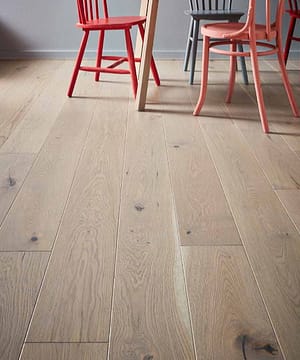
How Does It Fit?
There are two different profiles for how the floor planks fit together. Firstly, it comes with tongue and groove edges which can be secret-nailed to a wooden sub-floor, or glued down if laying onto a concrete base. Secondly, we sell a large selection of an easy-to-fit click-together system that can be installed as a floating floor, making installation faster and easier.
Engineered wood flooring by species
Oak is by far the most popular choice, but we stock a full range of wood species, each with its own character:
Looking for something with more character? Browse our rustic wood flooring range — rustic oak and engineered boards with natural knots, grain and colour variation.
We’re proud stockists of Boen engineered flooring — premium Norwegian oak, walnut and ash, available in UK-stocked, plank, 3-strip and handcrafted ranges.
Board width — standard to wide plank
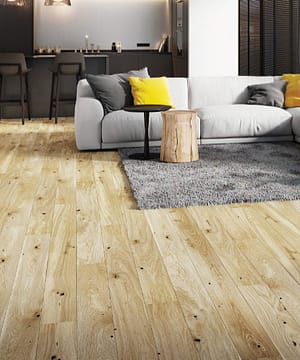
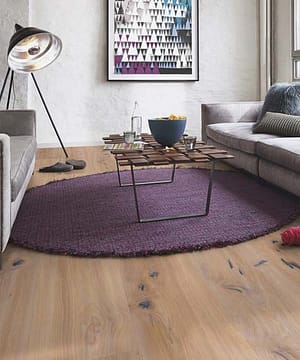
Width changes the whole feel of a floor. Narrower boards suit smaller or traditional rooms, while wide plank engineered wood flooring (190mm, 220mm and up to 300mm wide) gives a more open, contemporary look and shows off the grain. We carry everything from standard widths up to extra-wide planks across the range.
Thickness — 10mm to 21mm
Engineered boards come in a wide range of thicknesses. Thinner boards such as 10mm and 14mm engineered wood flooring are popular, cost-effective choices for most homes, while thicker boards like 18mm and 20mm engineered wood flooring have a thicker real-wood wear layer that can be sanded and refinished more times.
Finishes
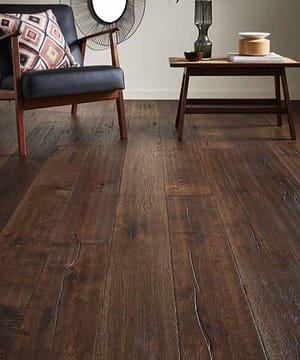
Choose from oiled, brushed & oiled, lacquered, hand-scraped, distressed and smoked finishes — or unfinished boards if you’d prefer to apply your own finish on site. We only supply flooring from reputable suppliers.
Frequently asked questions
What is the most popular wood species?
Oak is by far the most popular, thanks to its versatility and wide choice of shades. We also stock walnut, ash, maple and beech.
What finishes are available?
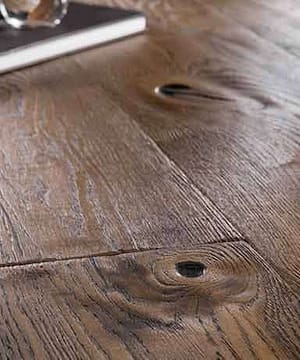
Oak can be brushed to raise the grain slightly, or heavily brushed for a rougher feel that helps mask scratches and dents. Hand-scraped boards are made to look aged, suiting a more traditional or cottage style.
What is the difference between prime grade and rustic grade?
Prime grade has very few defects for a clean, uniform look and sits at the higher end on price. Rustic grade has more character — knots, splits and dark filler — and is the more budget-friendly option, with a large selection to suit all tastes. Samples are available on all of our flooring.
Can engineered wood flooring be used with underfloor heating?
In most cases yes — ( except maple which is not suitable ) the stable multi-layer core handles the temperature changes that solid wood can’t. Suitability varies by board, so always check the individual product specification.
How wide do engineered boards go?
From standard widths up to wide and extra-wide planks of 190mm, 220mm and up to 300mm, for a more open, contemporary look.